
Home / Poker Rules & Hand Rankings
Poker Rules & Hand Rankings
This page covers the core rules and hand rankings for the main poker formats you will meet on X-Poker: Texas Hold’em, Pot-Limit Omaha (PLO4/5/6) and Short Deck (6+ Hold’em). The goal is to give beginners a clear, practical foundation before sitting down at a table.
Poker hand rankings
Hand rankings are the same in almost every common poker variant (with one important exception in Short Deck, covered later). From strongest to weakest:
| Rank | Hand | Example |
|---|---|---|
| 1 (strongest) | Royal Flush | A♠ K♠ Q♠ J♠ 10♠ |
| 2 | Straight Flush | 9♥ 8♥ 7♥ 6♥ 5♥ |
| 3 | Four of a Kind | Q♣ Q♦ Q♥ Q♠ 7♠ |
| 4 | Full House | J♠ J♥ J♦ 4♣ 4♠ |
| 5 | Flush | A♦ J♦ 8♦ 6♦ 2♦ |
| 6 | Straight | 10♣ 9♦ 8♠ 7♥ 6♣ |
| 7 | Three of a Kind | 8♠ 8♥ 8♦ K♣ 3♠ |
| 8 | Two Pair | A♠ A♦ 9♣ 9♥ 5♠ |
| 9 | One Pair | K♥ K♣ Q♠ 8♦ 3♣ |
| 10 (weakest) | High Card | A♠ J♦ 9♣ 6♥ 2♠ |
When two players have the same category (for example both have a pair), the higher ranking cards decide the winner. Suits are never used to break ties in standard poker.
How a hand is played
Almost every cash-game hand follows the same basic structure:
- Blinds / antes. Two players post the small blind and big blind (forced bets). Some formats also use antes from every player.
- Hole cards. Each player receives private cards face-down (the exact number depends on the game).
- Preflop. First betting round. Action starts with the player left of the big blind.
- Flop. Three community cards are dealt face-up. Second betting round.
- Turn. One more community card. Third betting round.
- River. Final community card. Last betting round.
- Showdown. If more than one player remains, hands are revealed and the best five-card combination wins the pot.
On each betting round a player may:
- Check — pass the action when no bet is facing them.
- Bet — put chips into the pot when no one has bet yet.
- Call — match the current bet.
- Raise — increase the current bet.
- Fold — surrender the hand and any chips already committed.
Texas Hold'em rules
Texas Hold’em is the most widely played poker game. Each player receives two private hole cards. Five community cards are dealt in the middle of the table (flop, turn, river). Players make the best five-card hand using any combination of their two hole cards and the five community cards. You may use both, one, or even none of your hole cards.
Betting structure is usually No-Limit (NLH): a player may bet any amount from the minimum raise up to their entire stack. Blinds are posted every hand; the dealer button moves clockwise after each hand so the blinds rotate.
Because only two hole cards are dealt, the hand rankings listed above apply exactly as written. Aces can be high or low for straights (A-2-3-4-5 is the lowest straight; 10-J-Q-K-A is the highest).
Pot-Limit Omaha (PLO4 / PLO5 / PLO6)
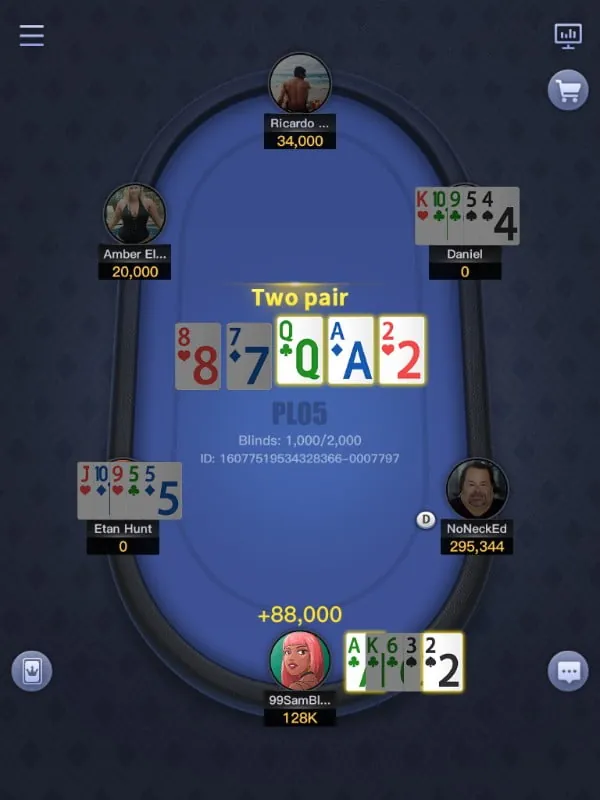
Omaha is similar to Hold’em but with two critical differences. First, each player is dealt more hole cards: four in PLO4, five in PLO5, or six in PLO6. Second — and most important — you must use exactly two of your hole cards together with exactly three community cards to form your hand. You cannot use only one hole card or three hole cards.
This rule changes everything. A player holding four hearts and seeing three hearts on the board does not automatically have a flush; they still need exactly two hearts from their hand plus three from the board. The same logic applies to every other combination.
Betting is Pot-Limit: the maximum raise is the size of the current pot (including any call you would make). This keeps stacks deeper relative to the pot than typical No-Limit Hold’em games and produces larger, more complex decisions.
Hand rankings themselves remain the standard ranking shown earlier. Only the way you construct the five-card hand is different.
Short Deck (6+ Hold'em)
Short Deck (also called 6+ Hold’em) uses a 36-card deck: all cards from 2 through 5 are removed, leaving 6, 7, 8, 9, 10, J, Q, K, A in each suit. Each player still receives two hole cards and five community cards are dealt, exactly as in regular Hold’em.
Because the deck is shorter, hand frequencies change and the ranking order is adjusted in one important way: a flush beats a full house. The full ranking from strongest to weakest in Short Deck is: Royal Flush, Straight Flush, Four of a Kind, Flush, Full House, Straight, Three of a Kind, Two Pair, One Pair, High Card.
Aces still play high and low. The lowest straight becomes A-6-7-8-9 (instead of A-2-3-4-5). Antes are common and the game is usually played No-Limit.
The shorter deck produces more action and higher average hand strength, which is why many players enjoy the format.
Other X-Poker formats
X-Poker also offers several specialty games such as All-in or Fold (AoF), Mau Binh and Bombpot tables. These formats keep the same basic hand rankings but change the betting rules or the way the pot is built. For a clear explanation of how each one works inside X-Poker, see the dedicated X-Poker game formats page.
FAQ
What beats what in poker?
From strongest to weakest: Royal Flush, Straight Flush, Four of a Kind, Full House, Flush, Straight, Three of a Kind, Two Pair, One Pair, High Card. In Short Deck the order of Flush and Full House is reversed.
How is PLO different from Hold'em?
In Omaha you receive four, five or six hole cards and must use exactly two of them plus exactly three community cards. In Hold’em you receive two hole cards and may use any number of them (including zero).
Why does a flush beat a full house in Short Deck?
With only 36 cards, flushes become rarer than full houses. The ranking was adjusted so that the scarcer hand (flush) ranks higher, preserving the principle that harder-to-make hands beat easier ones.
What is All-in or Fold (AoF)?
AoF is a simplified format in which the only preflop decisions are to go all-in or fold. There is no regular betting. Full details and how it runs on X-Poker are covered on the X-Poker game formats page.
Do these rules apply on X-Poker?
Yes. The rules described here are the standard rules used for Hold’em, PLO and Short Deck tables on X-Poker. Always check the specific table settings (blinds, ante, button type) before you sit, because clubs can configure small details.
Ready to put the rules into practice? Download X-Poker and join a club that offers the formats you want to learn.
Play only if you are 18 or older. This content is independent and is not published by the operator of the platform.

Heidy Tan J. — poker writer and club-app player
Heidy Tan J. is the name under which our author writes. She has played club-based poker apps since 2021 and X-Poker since November 2024, and writes about club-app poker in the Philippines, deposits and withdrawals via GCash and Maya, and player safety in private clubs. About the author and her experience.
Independent editorial guide — we are not the operator of X-Poker. This site earns from partner offers. Gambling involves risk; play only what you can afford to lose. Adults only.