
Home / Blog / How Poker Unions and Agents Work on Club Apps
How Poker Unions and Agents Work on Club Apps
Every major club poker application — X-Poker included — runs on a layered structure of clubs, unions and agents. Understanding that structure explains why you cannot simply open an account and deposit through a cashier, why rakeback percentages differ, and where the real risks sit. This article describes the theory; for practical club lists and how to join, see the X-Poker clubs page.
What is a club vs a union?
A club is the basic unit. A club owner creates a private room inside the app, sets the games and stakes that will run, and invites players. On its own, a small club often cannot fill enough tables to keep games alive.
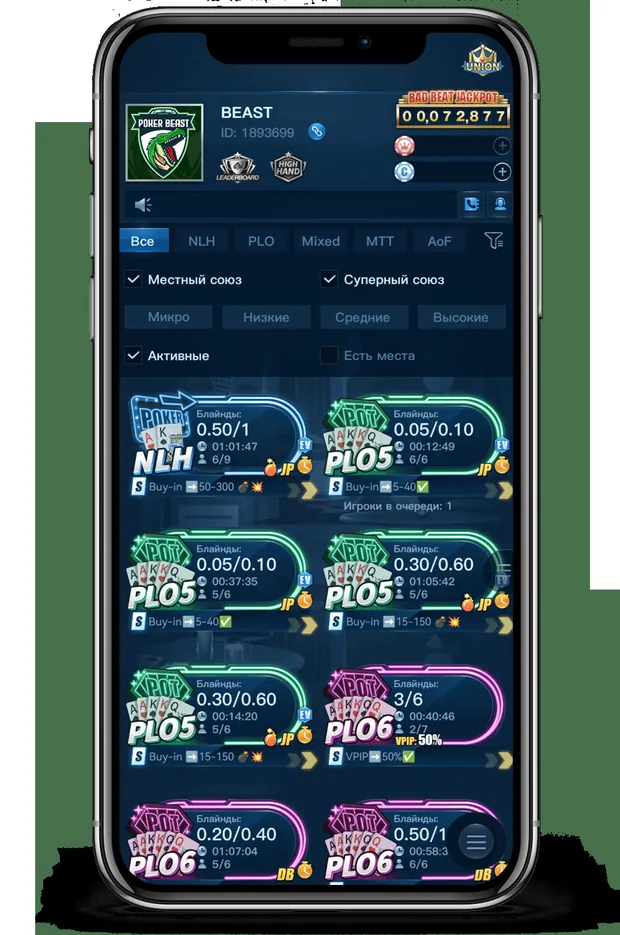
A union (sometimes called an alliance) solves the liquidity problem by linking many clubs into a shared player pool. When you sit at a table inside a union club, you are playing against players from every other club in that union. Rake and results are tracked across the network and settled between the participating clubs. Unions are the reason a club with only a few dozen regulars can still offer continuous action.
The agent & super-agent system
Players almost never deal directly with the club owner. Instead they are introduced and managed by an agent. The agent handles the practical work: adding the player to the club, receiving deposits, sending withdrawals, and distributing rakeback.
Larger operations use super-agents (or master agents). A super-agent recruits and manages a down-line of ordinary agents, takes a cut of the rake those agents generate, and often provides tools, marketing support or shared liquidity. From the player’s point of view the difference is invisible: you still talk to one agent. From the business side the hierarchy can be several layers deep.
There is no “official” agent of the software itself. Agents are independent contractors or partners of clubs and unions. Anyone claiming to be the sole authorised representative of the whole platform is misrepresenting the model.
How rake & rakeback flow through agents
When you play a hand, the club takes rake according to its posted structure. That gross rake is then split. A typical (but not universal) flow looks like this:
- A percentage goes to the union for providing the shared lobby and settlement infrastructure.
- A percentage stays with the club as operating margin.
- The remaining majority is distributed to agents as commission based on the rake generated by their players.
The agent then decides how much of their commission to return to the player as rakeback. That is why rakeback offers vary: two agents in the same club can have different personal agreements with the club or union, and each keeps a different margin.
Rakeback is therefore not a platform-wide promotion; it is a private commercial arrangement between you and your agent.
Why club apps use this model
The agent-and-union structure exists for several practical reasons. First, it solves liquidity: small groups of players can still find games. Second, it outsources customer acquisition and payment handling to people who already have local networks and payment methods. Third, it keeps the software company itself at arm’s length from real-money flows in many jurisdictions.
For players the upside is access to soft, private games and flexible crypto banking. The downside is that trust is personal rather than institutional.
Risks of the agent model
Because money moves outside the software, the primary risk is counterparty risk with the agent. Delayed withdrawals, changing wallet addresses, or sudden disappearance of an agent are the classic failure modes. Clubs and unions can also impose sudden rule changes or freeze balances in disputes.
Mitigation is the same as on any club app: work with agents who have a public track record, start small, keep only working capital on the balance, and understand the deposit/withdrawal process before you send large amounts. Practical safety steps are detailed on the X-Poker payments page.
FAQ
Do I need an agent to play on X-Poker?
Yes. There is no public cashier. Access and banking both run through an agent who places you inside a club.
What is the difference between a club and a union?
A club is a single private room. A union is a network of clubs that share one player pool so that tables stay full.
Why do rakeback percentages differ between agents?
Each agent receives a commission from the club or union and then decides how much of that commission to pass on to players. Different commercial deals produce different offers.
Where can I find established clubs and agents?
See the X-Poker clubs page for practical starting points.
Adults only. This content is independent and is not published by the operator. Gambling involves risk of loss.

Heidy Tan J. — poker writer and club-app player
Heidy Tan J. is the name under which our author writes. She has played club-based poker apps since 2021 and X-Poker since November 2024, and writes about club-app poker in the Philippines, deposits and withdrawals via GCash and Maya, and player safety in private clubs. About the author and her experience.
Independent editorial guide — we are not the operator of X-Poker. This site earns from partner offers. Gambling involves risk; play only what you can afford to lose. Adults only.